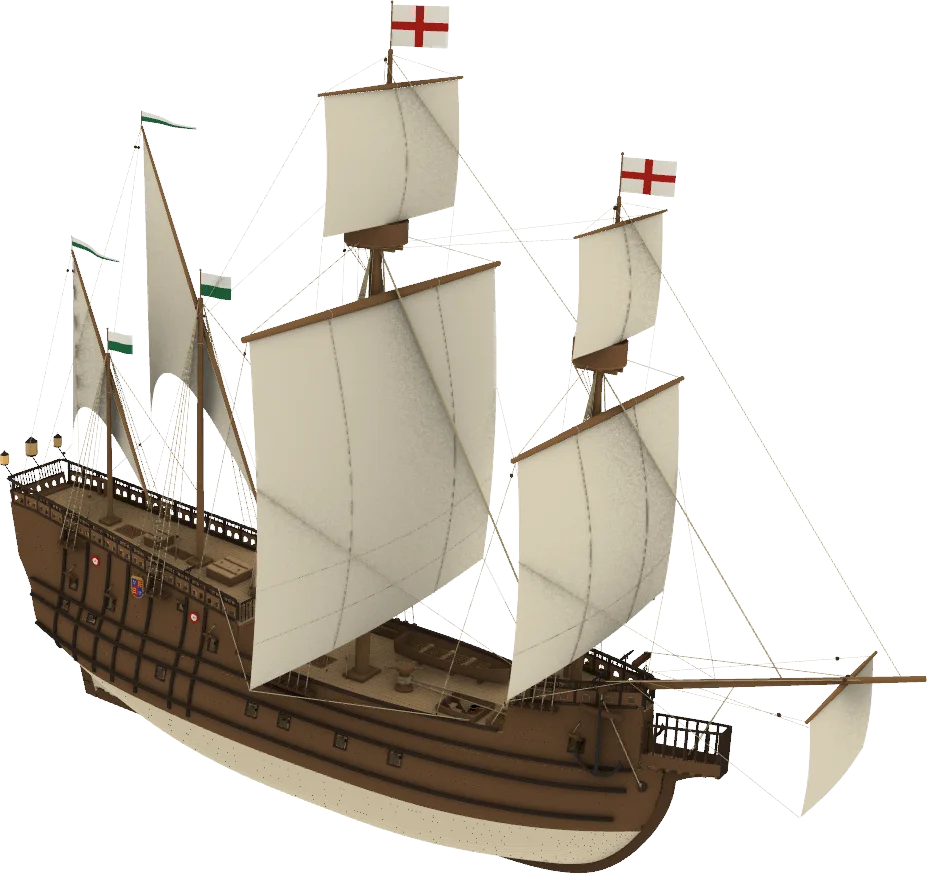
The King Watched Her Sink
A French invasion fleet lay off the English coast. Henry VIII watched from the shore as his favourite warship sailed out to meet it, heeled over and went down.
Read the story →A special exhibition · A day of remembrance
The story of Henry VIII's warship Mary Rose
The Solent, off Portsmouth · 19 July 1545
The King stood on the castle wall to watch his pride sail out to battle, her banners bright, her gunports open. A gust, a turn, a lurch to one side, and the sea rushed in through every port. Four hundred and more went down before his eyes.
Watch from the castle wallMary RoseCarrack · 1545 · 47.98 m, stern gallery to beakhead
The French fleet
Here she lies
Mary Rose
11 metres down · the Solent, off Portsmouth
Raised in 1982; now in Portsmouth, beside HMS Victory
The Mary Rose had served King Henry VIII for more than thirty years. She was one of the first English ships able to fire a broadside of heavy guns through ports cut in her side.
In July 1545 a great French fleet sailed into the Solent to attack Portsmouth. On 19 July the English ships went out to fight, while the King watched from Southsea Castle.
As she turned, the Mary Rose heeled over. Her lowest gunports were open, and water poured in. She sank within minutes. Netting meant to keep boarders out trapped her crew. Of around 400 men or more, fewer than 40 survived.
For more than four hundred years she lay in the silt of the Solent. In 1982 her hull was raised, watched live on television by millions of people around the world.
A corner of the exhibition
The pages of Mary Rose's life, as a watch officer might have written them.
Log of Mary RoseCarrack
Mary Rose
1545
Dressed overall
Mary Rose, spelled in the International Code of Signals, as a ship is dressed with flags from stem to stern. Touch a flag to read what it says when flown alone.
The mud preserved thousands of objects: longbows, guns, tools, clothes, even the bones of the crew and the ship's dog.
Today her hull stands in a museum at Portsmouth Historic Dockyard, beside HMS Victory.
Scientists have rebuilt the faces of some of her sailors from their skulls, so that we can look the lost crew in the eye.
A French invasion fleet lay off the English coast. Henry VIII watched from the shore as his favourite warship sailed out to meet it, heeled over and went down.
Read the story →A quiet corner
For those who sailed and did not come home. Light one, and watch it drift over the Solent, off Portsmouth.
The King watched her go down, and four centuries later the world watched her rise.
Remembered every year on 19 July