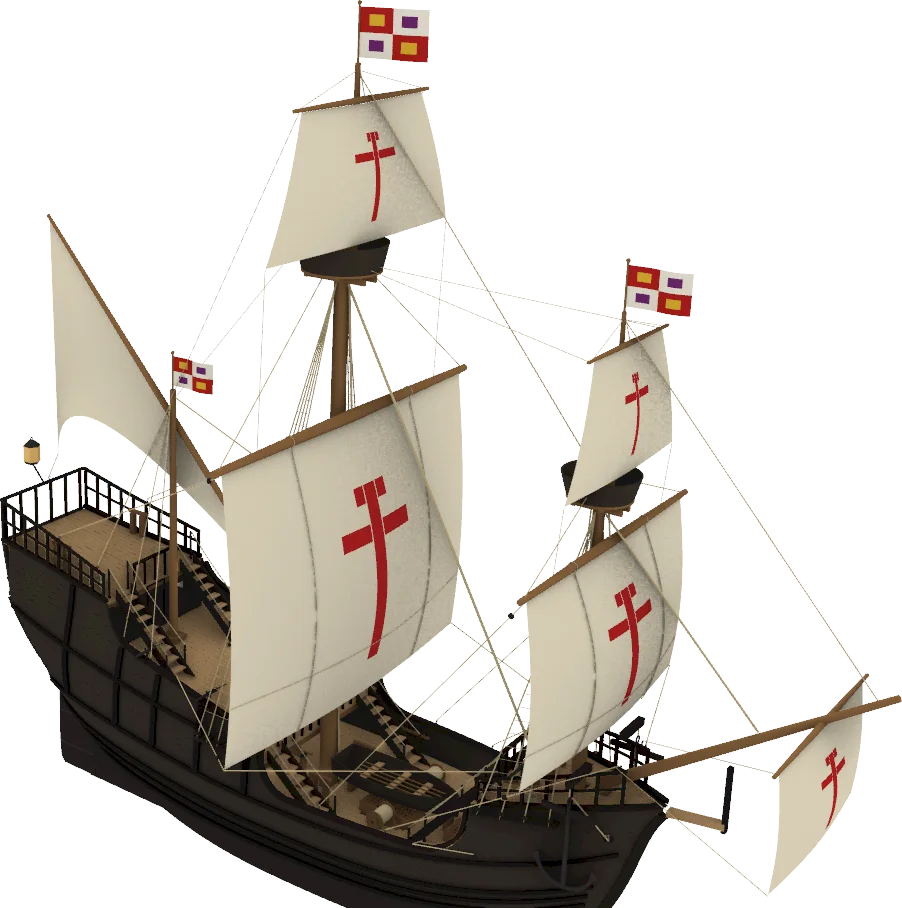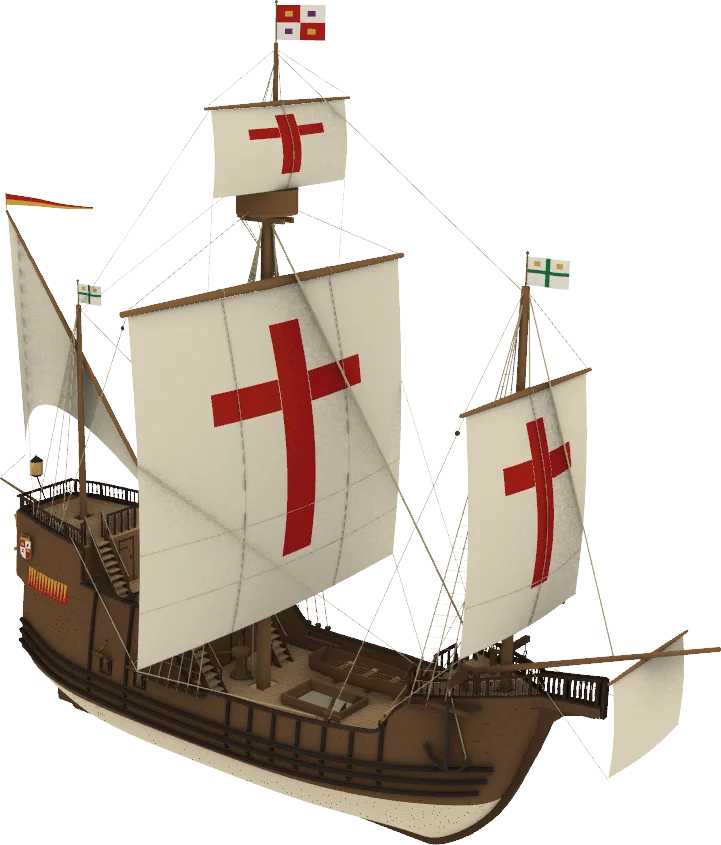
Santa María
Merchant ship Carrack (nao) · 1492
The flagship of Christopher Columbus crossed the Atlantic in 1492 and never came home. On Christmas Day she ran aground off Hispaniola.
Turn her in 3DVisit exhibit
Research, polar & expedition ships
The flagship of Christopher Columbus crossed the Atlantic in 1492 and never came home. On Christmas Day she ran aground off Hispaniola.
Five ships left Spain to sail around the world. Three years later, one battered ship came home with eighteen men. She was the first ship to circle the globe.
Built with a rounded hull so the ice would squeeze her upwards instead of crushing her, she sailed farther north and farther south than any wooden ship before her.
She was crushed by Antarctic ice in 1915. All 28 of her men came home, and 107 years later the world finally saw her again.
A wartime minesweeper became the most famous research ship in the world, carrying Jacques Cousteau and his cameras to show millions what lies beneath the waves.
Six men and a parrot sailed a raft of balsa logs from Peru across the Pacific for 101 days, to prove that ancient people could have done it too.
In 1960 two men sealed themselves inside a steel sphere beneath a float of petrol and sank to the deepest point in the ocean, nearly eleven kilometres down.
The world's first nuclear-powered surface ship. For thirty years she broke a path through the Arctic ice, able to sail for months without refuelling.
Designed and built in Istanbul, she listens to the rocks beneath the seabed, searching the eastern Mediterranean and beyond for oil and gas.