The Crane's Wing at Hansan Island
Admiral Yi Sun-sin lured a Japanese fleet out of a narrow strait, spread his ships in the shape of a crane's wings, and closed them around his enemy.
Read the story →A special exhibition · A day of victory
The story of Admiral Yi Sun-sin and the turtle ships
Hansan Island, Korea · 14 August 1592
Out of the narrow strait the Korean ships fled, and the invaders chased them into the open sea. Then the fleeing ships turned, and spread wide like the wings of a great white crane, and the cannons of Joseon spoke from every side.
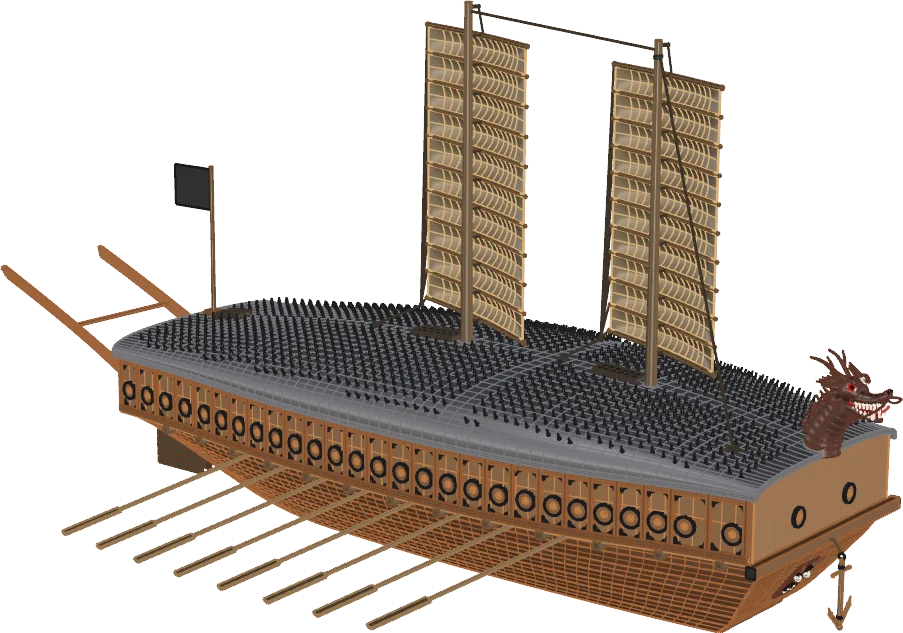
Spread the crane's wingsTurtle Ship (Geobukseon)Armoured war galley · 1592 · 36.47 m, horn tips to the dragon's snout; 26.15 m over the roofed house
Enemy guns
In 1592 a huge Japanese army invaded Korea and swept north. On land the Korean kingdom of Joseon was close to defeat. At sea, one admiral stood in the way: Yi Sun-sin.
A large Japanese fleet lay in the narrow strait of Gyeonnaeryang, where Korean ships could not manoeuvre. Admiral Yi sent a few ships in to attack, then had them turn and flee into the open water near Hansan Island.
The Japanese ships chased them. Suddenly the Korean fleet turned and spread into a great half-circle, the crane's wing formation, and closed around the enemy, firing cannon from every side.
Most of the Japanese fleet was sunk or captured. The armoured turtle ships led the attack, crashing into the enemy line. Few Korean ships were lost.
A corner of the exhibition
The pages of Turtle Ship (Geobukseon)'s life, as a watch officer might have written them.
Log of Turtle Ship (Geobukseon)Armoured war galley
Turtle Ship (Geobukseon)
1592
Dressed overall
Turtle Ship, spelled in the International Code of Signals, as a ship is dressed with flags from stem to stern. Touch a flag to read what it says when flown alone.
With the sea road blocked, the invaders could not supply their armies by sea, and the war turned.
Yi Sun-sin never lost a sea battle. He is honoured in Korea as one of the greatest admirals in history.
The armoured turtle ship, with its dragon head and iron-spiked roof, remains one of the most famous warships ever built.
Admiral Yi Sun-sin lured a Japanese fleet out of a narrow strait, spread his ships in the shape of a crane's wings, and closed them around his enemy.
Read the story →A sailor's corner
Eight bells end the watch. Ring them for every crew who sailed that day, and for every watch kept since.
Touch the bell
The crane spread its wings over Hansan, and an invasion was turned back at sea.
Remembered every year on 14 August