Ships Over the Hills
A great chain closed the Golden Horn to the Ottoman fleet. So Sultan Mehmed II did something no one believed possible: he sent his ships over the land.
Read the story →A special exhibition · A day of victory
The story of Fatih Sultan Mehmed's galleys and the conquest of Istanbul
Istanbul, the Golden Horn · the night of 21–22 April 1453
The chain lay across the Golden Horn and the city slept behind it, certain that no ship could pass. But in the night, by torchlight and muscle and will, the galleys climbed the hills on rollers of greased timber, and at dawn they were sailing in the harbour.
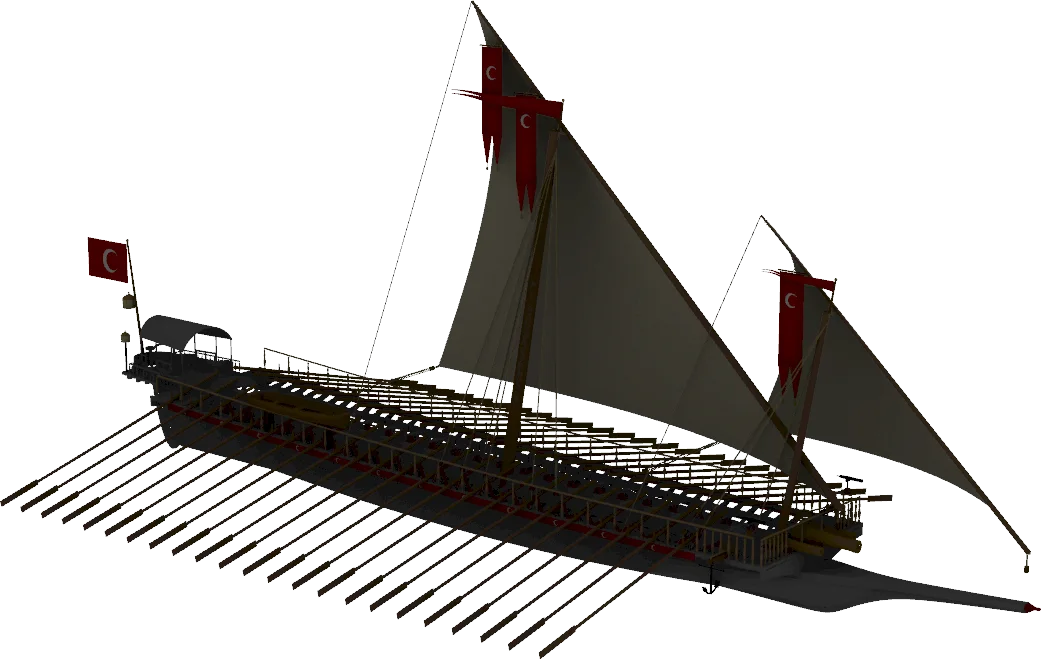
Follow the ships by torchlightOttoman KadırgaWar galley (kadırga) · 16th century · 39.64 m
In April 1453, the young Sultan Mehmed II laid siege to Constantinople. A massive iron chain stretched across the mouth of the Golden Horn, and behind it the city's ships kept the harbour safe. The Ottoman fleet could not break through.
If the ships could not pass the chain, they would go around it, over the land. A road was laid from the shores of the Bosphorus up over the hills behind Galata, paved with timber rollers greased with oil and fat.
On the night of 21 to 22 April, teams of men and oxen hauled the galleys, one after another, up the slopes and down the other side. Some say the sails were raised, as if the ships were sailing across the hills.
In the morning, the defenders looked out and saw around seventy Ottoman ships floating in the Golden Horn, behind the chain that was meant to stop them. The sea walls along the harbour now had to be defended too.
A corner of the exhibition
The pages of Ottoman Kadırga's life, as a watch officer might have written them.
Log of Ottoman KadırgaWar galley (kadırga)
Ottoman Kadırga
16th century
Dressed overall
Ottoman Kadırga, spelled in the International Code of Signals, as a ship is dressed with flags from stem to stern. Touch a flag to read what it says when flown alone.
Stretched thin along new walls, the defenders held out for five more weeks. On 29 May 1453, Istanbul was taken and a new age began.
The young Sultan was only twenty-one. The overland passage became one of the most famous feats of military engineering in history.
The route of the ships is remembered in Istanbul's place names and in the Panorama 1453 museum, where the night is painted on the walls.
A great chain closed the Golden Horn to the Ottoman fleet. So Sultan Mehmed II did something no one believed possible: he sent his ships over the land.
Read the story →A sailor's corner
Eight bells end the watch. Ring them for every crew who sailed that day, and for every watch kept since.
Touch the bell
They said no ship could pass the chain. In one night of torches and timber, a young Sultan proved them wrong.
Remembered every year on 22 April