Trafalgar
Twenty-seven British ships against thirty-three. Nelson broke the rules of naval battle, and changed the sea for a hundred years.
Read the story →A special exhibition · A day of victory
The story of HMS Victory and the Battle of Trafalgar
Cape Trafalgar, Spain · 21 October 1805
Before noon the flags went up on Victory's mast, a signal to every ship in the fleet. Two columns of oak bore down on the enemy line, through the smoke and thunder, and broke it. By evening the battle was won, and the admiral who won it lay dying below decks.
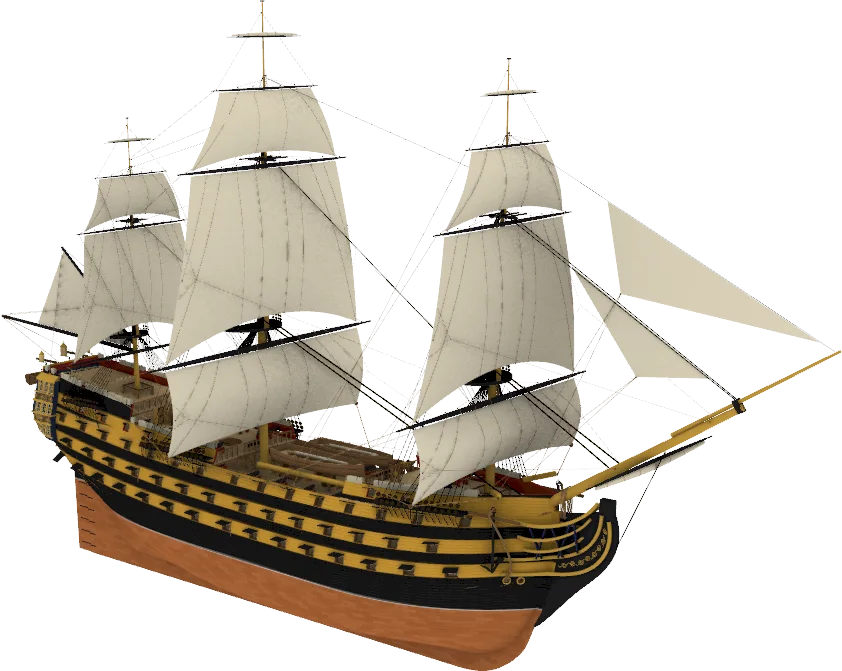
Break the lineHMS VictoryShip of the line · 1765 · 94.75 m, spanker boom to jib-boom
Enemy guns
In October 1805 a combined French and Spanish fleet of 33 ships of the line sailed out of Cádiz. Admiral Lord Nelson was waiting with 27.
As the fleets closed, Nelson hoisted a signal from HMS Victory: England expects that every man will do his duty. The sailors cheered it from ship to ship.
Instead of forming a line alongside the enemy, Nelson sent his ships in two columns straight at it, to cut it into pieces. For long minutes the leading ships took fire without being able to reply.
In the heat of the battle a marksman in the rigging of the French ship Redoutable shot Nelson on Victory's quarterdeck. He was carried below and died that afternoon, knowing the battle was won.
Twenty-two enemy ships were captured or destroyed, and not one British ship was lost. That night a great storm wrecked many of the prizes, and thousands more sailors drowned.
A corner of the exhibition
The pages of HMS Victory's life, as a watch officer might have written them.
Log of HMS VictoryShip of the line
HMS Victory
1765
Dressed overall
Victory, spelled in the International Code of Signals, as a ship is dressed with flags from stem to stern. Touch a flag to read what it says when flown alone.
After Trafalgar, Britain's navy ruled the oceans for a century, and Napoleon never again threatened to invade.
Every 21 October is remembered as Trafalgar Day. Nelson's column stands above Trafalgar Square in London.
HMS Victory is preserved in dry dock at Portsmouth, still a commissioned ship of the Royal Navy.
Twenty-seven British ships against thirty-three. Nelson broke the rules of naval battle, and changed the sea for a hundred years.
Read the story →A sailor's corner
Eight bells end the watch. Ring them for every crew who sailed that day, and for every watch kept since.
Touch the bell
Every man did his duty off Cape Trafalgar, and the admiral who asked it of them gave his life.
Remembered every year on 21 October