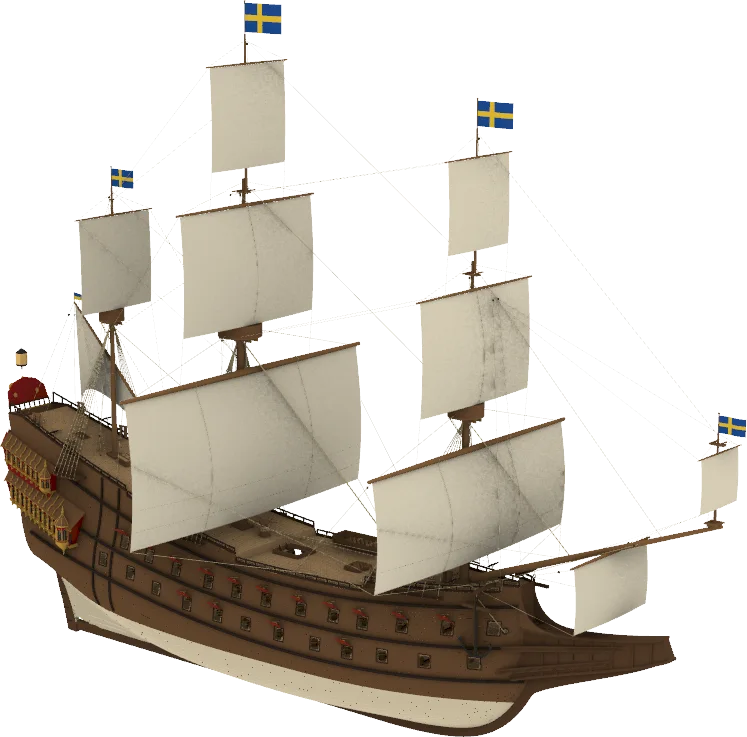
The Shortest Maiden Voyage
Crowds lined the shore to watch the King's new warship set out. She had sailed little more than a kilometre when the wind caught her.
Read the story →A special exhibition · A day of remembrance
The story of the Swedish warship Vasa
Stockholm harbour, Sweden · 10 August 1628
Gold on her stern and lions on her bow, she sailed out before the whole of Stockholm to the thunder of her own salute. A breath of wind, and then another, and the King's great ship lay down in the harbour and sank before the eyes of the city.
Go down to herVasaShip of the line (galleon) · 1628 · 69 m with her spars; 47.5 m between perpendiculars
A gust of wind
Here she lies
Vasa
32 metres down · Stockholm harbour, Sweden
Raised in 1961; she stands whole in her own museum in Stockholm
King Gustavus Adolphus of Sweden wanted the most powerful warship in the Baltic. The Vasa carried 64 guns on two gun decks and hundreds of painted and gilded carvings: lions, heroes, gods and emperors.
On Sunday 10 August 1628, crowds lined the shore as she set sail from Stockholm, firing a salute. A light gust of wind made her heel. She came upright, then a second gust laid her over again.
Water poured in through her open lower gunports. Within minutes she sank in the harbour, having sailed little more than a kilometre. Around thirty people died.
The cold, brackish water of the Baltic, free of the shipworm, kept her almost whole. In 1961 she was raised, and today she stands in the Vasa Museum in Stockholm, more than 95 percent original.
A corner of the exhibition
The pages of Vasa's life, as a watch officer might have written them.
Log of VasaShip of the line (galleon)
Vasa
1628
Dressed overall
Vasa, spelled in the International Code of Signals, as a ship is dressed with flags from stem to stern. Touch a flag to read what it says when flown alone.
She was top-heavy, with too little ballast for her two heavy gun decks. Engineers still study her as a lesson in design.
The Vasa is the best-preserved seventeenth-century ship in the world, visited by more than a million people a year.
An inquiry was held, but no one was blamed. The King had approved her design, and her builder had died a year before she sailed.
Crowds lined the shore to watch the King's new warship set out. She had sailed little more than a kilometre when the wind caught her.
Read the story →A quiet corner
For those who sailed and did not come home. Light one, and watch it drift over Stockholm harbour, Sweden.
She sailed for twenty minutes and slept for three hundred and thirty-three years. Now she stands again, as proud as on the day she sank.
Remembered every year on 10 August