Lepanto: The Last Great Galley Battle
More than four hundred galleys met at the mouth of the Gulf of Patras. It was the largest naval battle of its age, and the last great battle fought with oars.
Read the story →A special exhibition · A day of remembrance
The story of the Ottoman galleys at the Battle of Lepanto
The Gulf of Patras, Greece · 7 October 1571
Two great fleets rowed toward each other across the morning sea, oars rising and falling like the wings of a thousand birds. By evening the sea was red and strewn with broken oars, and the age of the galley had seen its last great day.
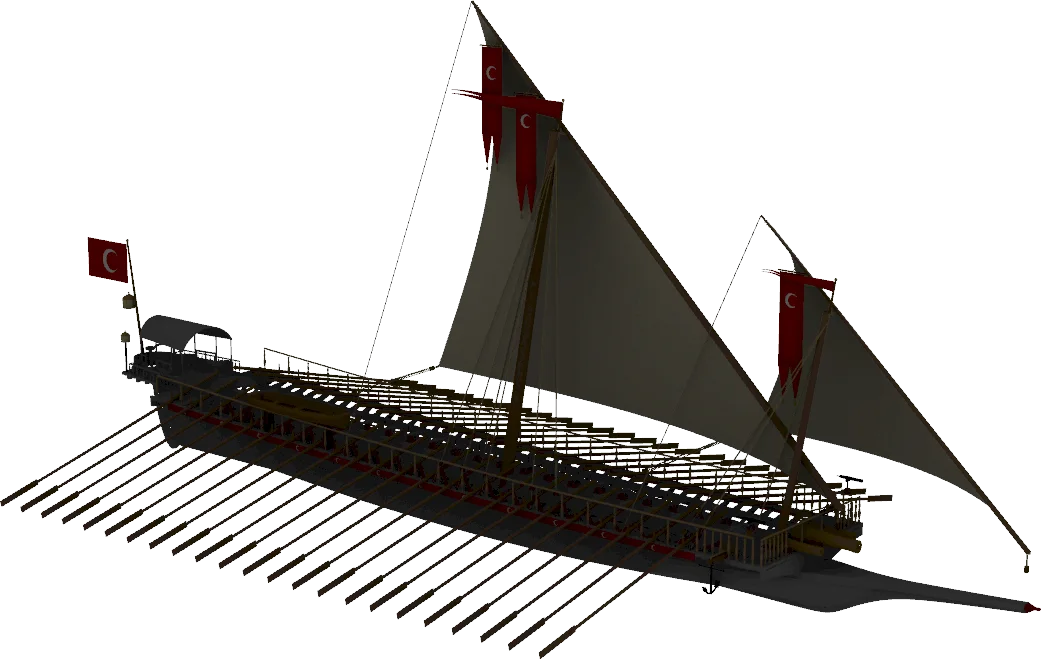
Into the battle lineOttoman KadırgaWar galley (kadırga) · 16th century · 39.64 m
Enemy guns
Here she lies
Ottoman Kadırga
Depth unknown · the Gulf of Patras, Greece
After the Ottoman conquest of Cyprus, a new Holy League of Spain, Venice and the Pope sent a great fleet east under Don John of Austria. The Ottoman fleet under Müezzinzade Ali Pasha came out to meet it at the mouth of the Gulf of Patras.
On 7 October 1571, more than four hundred galleys met. The Holy League had placed heavy Venetian galleasses, floating gun platforms, in front of its line. Their cannon broke the Ottoman formation before the fleets even met.
The galleys crashed together and the battle became a fight of boarding parties on the decks. Ali Pasha's flagship was taken and the admiral was killed. Only the Ottoman left wing under Uluç Ali fought its way out.
Most of the Ottoman fleet was lost, and tens of thousands of men died on both sides. Thousands of Christian galley slaves chained to Ottoman oars were set free.
A corner of the exhibition
The pages of Ottoman Kadırga's life, as a watch officer might have written them.
Log of Ottoman KadırgaWar galley (kadırga)
Ottoman Kadırga
16th century
Dressed overall
Ottoman Kadırga, spelled in the International Code of Signals, as a ship is dressed with flags from stem to stern. Touch a flag to read what it says when flown alone.
Within a year the Ottomans had built a new fleet. Grand Vizier Sokollu Mehmed Pasha told the Venetians that taking Cyprus had cost them an arm, while Lepanto had only shaved the Ottoman beard.
Uluç Ali, who saved his ships, was named Kılıç Ali Pasha, Ali of the Sword, and led the rebuilding of the navy.
Lepanto was the last great battle fought mainly by oared ships. The future belonged to sail and cannon. Among the wounded was a young Spanish soldier named Miguel de Cervantes.
More than four hundred galleys met at the mouth of the Gulf of Patras. It was the largest naval battle of its age, and the last great battle fought with oars.
Read the story →A quiet corner
For those who sailed and did not come home. Light one, and watch it drift over the Gulf of Patras, Greece.
Thousands of oars fell silent off Lepanto. Remember the men of both fleets who never rowed home.
Remembered every year on 7 October